Smartphone Screen Replacement Guide: TFT, In-Cell, Hard vs Soft OLED, OEM & Service Pack
Confused by replacement screen choices? From budget In-Cell LCDs to premium Soft OLEDs, Refurbished OEM, and official Service Packs, here is the complete technician guide to display technologies, durability, and which screen fits your budget.
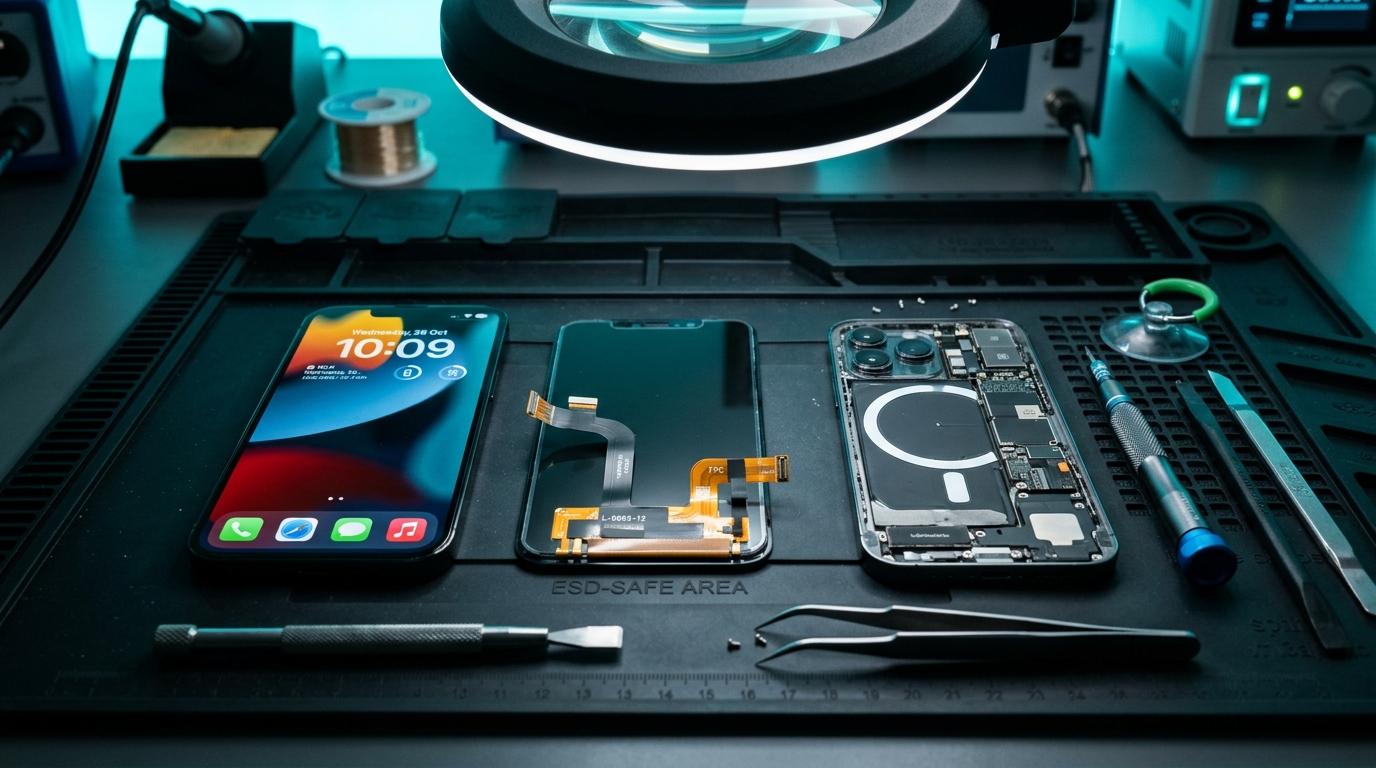
Why Replacement Screen Prices Vary So Wildly
When you break your smartphone display and ask for repair quotes in Marrakesh, you will often receive wildly different prices for the exact same device. For instance, replacing an iPhone screen might be quoted at 350 MAD by one shop, 700 MAD by another, and 1,500 MAD for an official panel.
Are you being overcharged, or is there a genuine difference in hardware? The truth lies in the vast spectrum of display technologies and manufacturing grades sold in the global aftermarket.
From basic TFT LCDs to cutting-edge Soft OLEDs and factory Service Packs, each tier offers distinct trade-offs in color vibrancy, touch sampling rate, thickness, drop resistance, and battery consumption. Below, our hardware engineering team breaks down every screen type available in today's market.
LCD Display Technologies: TFT vs In-Cell
LCD (Liquid Crystal Display) is an older, backlit display technology. Because LCDs require an LED backlight grid behind the color pixels, they are physically thicker and draw continuous power regardless of whether you display white or pure black.
TFT (Thin-Film Transistor LCD)
-
What It Is: The most basic and inexpensive aftermarket screen tier. TFT displays use a separate glass substrate, liquid crystal layer, polarizing filters, and a bulky backlight diffuser unit.
-
Image Quality: Low to mediocre contrast ratio. Blacks appear distinctly dark-gray because the backlight never turns off. Viewing angles are limited, with colors shifting or washing out when tilted.
-
Thickness & Fit: TFT panels are considerably thicker than original OLEDs. When installed on an iPhone or Samsung phone originally engineered for OLED, the screen will noticeably protrude past the phone chassis, leaving an uncomfortable ridge.
-
Durability & Power: TFT draws up to 30% to 40% more battery power than an OLED on dark mode. Because the panel is stiff and thick, edge impacts crack the matrix easily.
-
Technician Verdict: Only recommended as an emergency budget fix or for older phones that originally shipped with LCD displays.
In-Cell / INCELL LCD
-
What It Is: An advanced evolution of LCD where the capacitive touch digitizer sensors are fused directly inside the liquid crystal cell, eliminating an entire layer of glass and adhesive.
-
Image Quality: Significantly better color saturation and higher refresh responsiveness than traditional TFT. Peak brightness reaches 500-600 nits, offering decent outdoor usability.
-
Thickness & Fit: Much thinner than standard TFT, sitting much closer to flush within the smartphone frame.
-
Pros & Cons: It is the most popular budget aftermarket replacement for OLED iPhones (such as iPhone X, 11 Pro, 12, 13, and 14). However, it remains an LCD: dark mode will not save battery, deep blacks remain charcoal gray, and the bottom chin bezel is slightly thicker than original.
-
Technician Verdict: The best low-cost alternative for budget-conscious users who want responsive touch without paying the premium for OLED.
The OLED Family: Contrast, Flexibility & Substrates
OLED (Organic Light Emitting Diode) uses millions of individual microscopic diodes that emit their own light. When a pixel is black, it completely turns off (0 nits), creating infinite contrast, true blacks, ultra-wide viewing angles, and substantial battery savings with dark mode.
Standard OLED & AMOLED
-
What It Is: AMOLED (Active Matrix OLED) is Samsung's signature implementation of OLED, while Apple uses custom-tuned OLED panels across its flagship lineup.
-
Visual Performance: Infinite contrast (1,000,000:1+), instantaneous pixel response time (<1ms), and DCI-P3 cinema color gamut coverage.
-
Energy Efficiency: True dark mode saves up to 30% to 50% battery life on OLED because turned-off pixels consume zero electrical power.
Hard OLED (Rigid Glass Substrate)
-
What It Is: Hard OLED panels are built using a flat, rigid glass substrate beneath the OLED layer.
-
Image Quality: Exceptional color reproduction, pitch-black contrast, and slim profile that rivals the original screen.
-
The Fatal Flaw (Fragility): Because the substrate is brittle glass, it cannot absorb shock. If your phone drops on a corner or the frame suffers torsion pressure in your pocket, the internal Hard OLED glass can crack without the outer protective glass even breaking, resulting in purple blotches, vertical neon lines, or a total black screen.
-
Technician Verdict: High visual fidelity at an attractive price point, but requires a shock-absorbent rugged case to prevent internal panel fractures.
Soft OLED (Flexible Polyimide Substrate)
-
What It Is: Soft OLED panels use a flexible polyimide plastic substrate instead of glass. This is the exact same underlying architecture utilized by Apple, Samsung, and Google in factory-original flagship devices.
-
Fit & Bezels: Because the bottom of the panel can gently curve inward inside the frame, Soft OLED achieves the original ultra-thin bottom bezel (chin) with zero protrusion.
-
Durability: Tremendously more shock-resistant than Hard OLED. It flexes upon impact rather than shattering internally.
-
Touch & Features: Fully supports 3D Touch/Haptic Touch, ambient TrueTone transfer, high touch sampling rates, and optimal color accuracy.
-
Technician Verdict: The gold standard of aftermarket screen replacements. It offers 95-98% of original performance, durability, and aesthetics at a fraction of official service center costs.
Flexible OLED
-
What It Is: Displays engineered on ultra-thin flexible polymers designed specifically for curved edges (such as Samsung Galaxy S21 Ultra, S22 Ultra, S23 Ultra) or foldable devices (Galaxy Z Fold, Z Flip).
-
Technician Verdict: Essential for curved-edge phones. Installing any rigid or flat replacement on a curved chassis leads to immediate frame detachment and ghost touches.
Manufacturing & Quality Grades: What Are You Buying?
Beyond the raw display panel type, the sourcing grade determines whether your replacement lasts for years or fails within weeks.
Original OLED (Factory Assembled)
-
New display panels produced by Tier-1 display manufacturers (Samsung Display, LG Display, BOE) meeting full factory assembly specifications. Unmatched brightness in intense sunlight (essential for Moroccan summers), factory touch controllers, and zero latency.
Refurbished / Original Pulled (Cleanroom Re-glassed)
-
What It Is: An authentic, 100% genuine factory OLED or LCD where only the top outer glass was cracked, while the underlying original display matrix and touch digitizer remained flawless.
-
The Refurbishing Process: In an industrial dust-free cleanroom, technicians freeze the cracked screen to -150°C using liquid nitrogen to delaminate the broken glass, clean the polarized film, and apply brand-new tempered glass with Optically Clear Adhesive (OCA) inside a high-pressure autoclave chamber.
-
Why Technicians Love It: You get a 100% genuine original display matrix with factory color calibration, original 120Hz ProMotion refresh rate, and factory touch accuracy for much less than a new service pack.
OEM / OEM Quality
-
Manufactured by reputable aftermarket electronics factories adhering to strict OEM technical tolerances. These units utilize high-grade touch driver ICs, proper capacitive copper shielding, and accurate color temperature profiles. Highly reliable when sourced from certified suppliers.
Service Pack (Official Factory Sealed Box)
-
What It Is: The holy grail of replacement displays. An authentic, brand-new replacement module shipped directly in the manufacturer's sealed anti-static service box (e.g. Samsung Service Pack, Xiaomi Official Service Pack).
-
What's Included: Samsung Service Packs typically come pre-assembled with a brand-new metal chassis, factory-bonded side volume/power buttons, earpiece speaker mesh, and frequently a brand-new factory battery already adhered in place.
-
Technician Verdict: Zero compromise. Perfect fit, 100% factory water-resistant seal tolerance, and instant manufacturer hardware compliance.
Bare Screen vs Screen + Frame Assembly
When choosing a replacement screen, you will often see options for "Without Frame" or "With Frame":
LCD + Frame vs OLED + Frame
-
Bare Screen (Without Frame): Requires the technician to manually scrape dried glue and glass shards from your old bent chassis, apply liquid adhesive (such as B-7000 or T-7000), clamp the phone with rubber bands for hours, and hope the warped frame doesn't exert uneven pressure on the new display.
-
Screen + Frame (Pre-assembled Housing): The display is thermally fused to a brand-new CNC aluminum/magnesium alloy frame straight from the factory cleanroom.
-
Why We Always Recommend "+ Frame":
1. Perfect Alignment: Zero gaps, zero light bleed along the edges, and flawless speaker mesh alignment.
2. Superior Impact Protection: If your original phone frame was bent or dented on the corners, a bare screen will crack almost immediately. A new frame restores structural integrity.
3. Factory Water Sealing: Pre-cut die gaskets restore ingress protection against dust and humidity.
Comparison Matrix: Quick Buying Guide
| Screen Type | Panel Technology | Color & Blacks | Impact Resistance | Battery Impact | Best Suited For |
|---|---|---|---|---|---|
| TFT LCD | Backlit LCD | Gray blacks, washed out | Low (thick & brittle) | High (+35% drain) | Ultra-budget temporary repairs |
| In-Cell LCD | Integrated Touch LCD | Deep gray, good colors | Moderate | Medium (+20% drain) | Budget replacement for OLED iPhones |
| Hard OLED | Rigid Glass OLED | Pure black, high contrast | Low (internal glass shatters) | Excellent (Power efficient) | Budget-conscious OLED users with heavy cases |
| Soft OLED | Flexible Polyimide OLED | Pure black, vibrant cinema | High (shock-absorbent) | Excellent (OEM level) | Recommended: Best balance of price & durability |
| Refurbished OEM | Genuine Factory OLED | 100% Original Apple/Samsung | Original factory grade | Factory optimal | Discerning users wanting 100% original quality |
| Service Pack | Official Brand Sealed | 100% Factory Certified | Maximum (New chassis) | Factory optimal | Flagships wanting zero compromises & warranty |
How DIGITAL REVIVE Replaces Screens in Marrakesh
At our workshop in Complexe Artisanal, Marrakesh, we believe in complete transparency. We test every panel before installation and always provide:
1. TrueTone & Ambient Light Sensor Reprogramming: Using specialized EEPROM programmers, we transfer display calibration data from your broken screen to the new panel so TrueTone and auto-brightness function seamlessly.
2. Factory Waterproof Gasket Seals: We clean out old residue and apply pre-cut laser-cut perimeter adhesive gaskets to keep Marrakesh dust and accidental moisture out of your device.
3. 90-Day Parts & Labor Warranty: Every screen installed at DIGITAL REVIVE comes backed by our comprehensive guarantee for your peace of mind.
Need advice on which screen tier makes the most sense for your phone and budget? Contact our technicians on WhatsApp or visit our workshop today!
Component-Level Repairs & Diagnostics
Experiencing battery degradation, thermal overheating, display issues, or logic board failure? Visit our Marrakesh workshop at Complexe Artisanal or contact our engineers on WhatsApp for a fast, free diagnostic consultation.
DIGITAL REVIVE Engineering Team
Author & Lab TechniciansSpecialized in micro-soldering, SMD board repairs, liquid damage decontamination, and precision smartphone diagnostics at Complexe Artisanal, Marrakesh. Over 5,000+ devices restored.
Related Guides & Tips
❌ Why You Should NOT Put a Wet Phone in Rice
The hard science debunking the raw rice myth. Learn how rice starch dust creates conductive cement and accelerates copper trace corrosion.

💧 Dropped Your Phone in Water? What You Should Do Immediately
The critical first 10 minutes after liquid contact. Why you must power down immediately, avoid chargers, and seek professional ultrasonic cleaning.

📶 Phone Has No Network After Repair: What to Check
Searching... or No Service after replacing a screen or housing? Pinpointed coaxial antenna cable tears, grounding clips, and RF transceiver faults.